
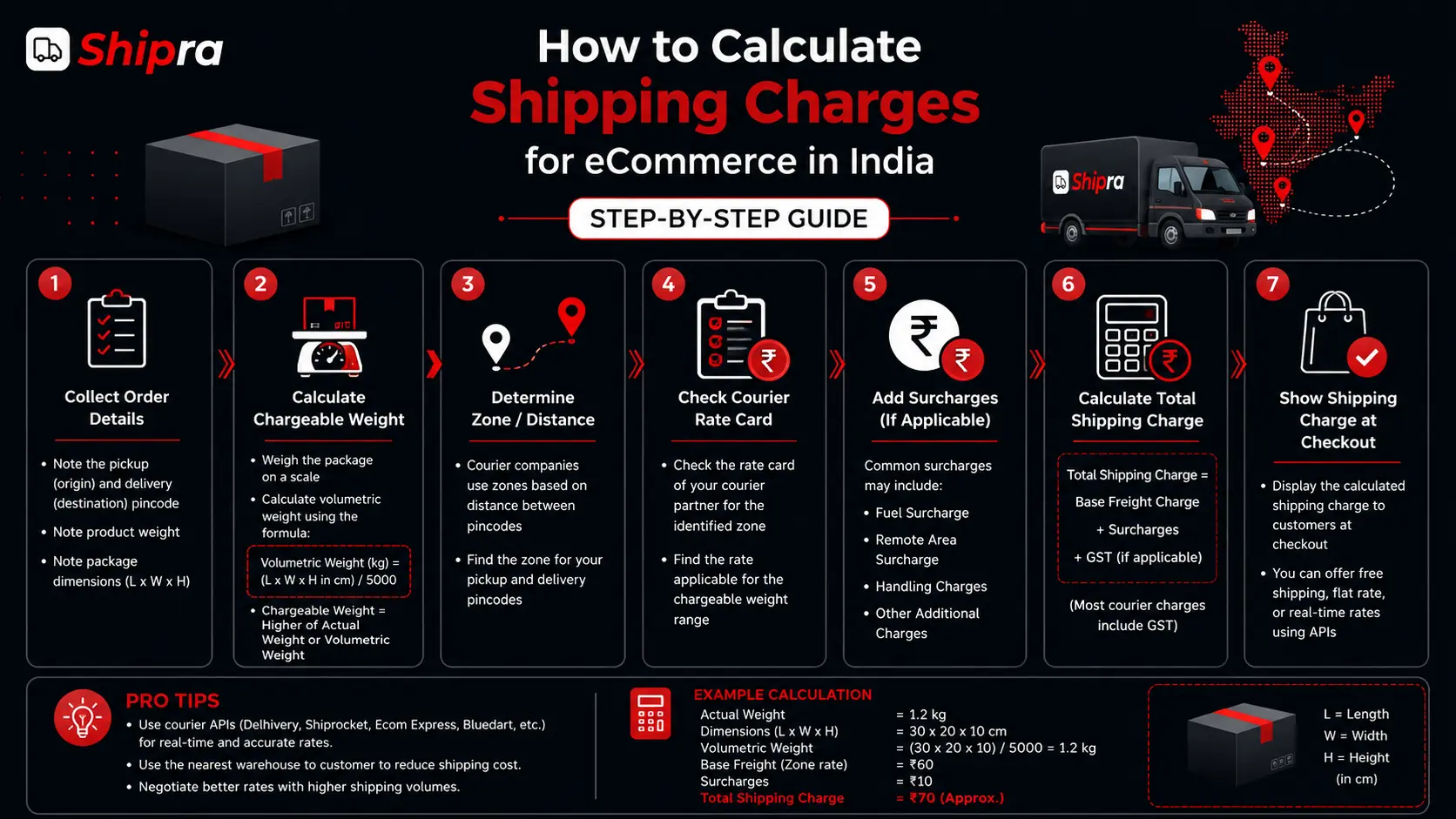
Shipping costs in Indian ecommerce don’t behave like a fixed price tag. Every order ships at a different cost, and most sellers find this out the hard way when the courier invoice lands at month-end. If you’ve been guessing, this post will fix that. You’ll learn how to calculate shipping charges for any order, what the formula for shipping costs actually looks like, and where the real savings hide once you understand the math.
This is the same calculation logic Shipra uses inside its dashboard for over 420K Indian businesses that ship every day. Read through, apply it tomorrow, stop losing money to courier billing surprises.
What Are Shipping Charges in Ecommerce?
Shipping charges are what your courier bills you for moving a package from your warehouse to your customer’s door. The number shifts based on how heavy the package is, how big it is, where it’s going, how fast it has to reach, and whether the order is prepaid or COD. Add fuel surcharge and GST on top of all that, and you get the final bill.
Some sellers add this to the product price. Others absorb it and call it free shipping. Both work, but only when you know the actual cost first.
Why Accurate Shipping Cost Calculation Matters
Wrong shipping math hurts in a way that’s easy to miss till it adds up. Picture this: you quote a customer ₹40 for shipping. Actual courier bill turns out ₹95. You eat ₹55 on that order. Run 200 orders like this in a month and you’ve lost ₹11,000 quietly, without anyone noticing.
Most Indian ecommerce sellers lose 12-18% of their revenue to logistics. A good chunk of that loss comes from calculation errors. Once you shipping cost calculate properly for every order, your margins stop bleeding.
Factors That Affect Shipping Charges in India
Seven things go into your final shipping bill. Knowing each one helps you spot where the money is leaking.
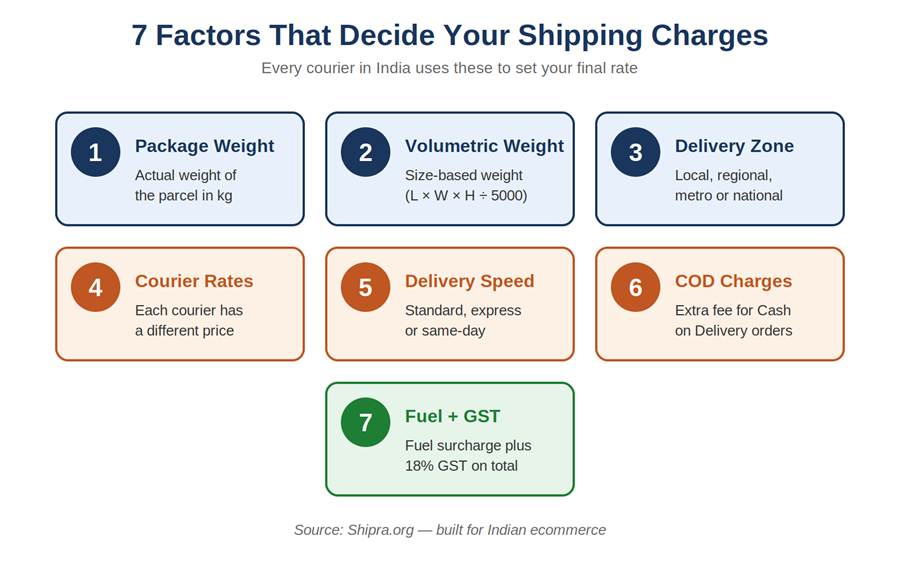
Package Weight
Actual weight of the parcel on a scale. Couriers bill in 500g slabs, so a 1.2 kg package usually gets charged like a 1.5 kg one. Round up when you estimate, never down.
Volumetric Weight
This is the size-based weight. A big light box like a packed soft toy takes more space inside a courier van than its actual weight suggests. The courier charges you for that space. We’ll cover the formula in a minute.
Delivery Distance and Shipping Zones
Indian couriers split the country into zones: local, regional, metro, national, and special locations like the Northeast, Jammu, Kashmir, and the islands. Local is the cheapest. Special zones cost 2-3 times more than local for the same weight.
Courier Partner Rates
Delhivery, Blue Dart, DTDC, Ecom Express, XpressBees, Shadowfax. Each one prices differently. The same shipment can vary by 30-40% across couriers. Shipra compares rates from all of them automatically before every shipment, which is why sellers using Shipra save 15-25% on shipping costs without changing anything else.
Delivery Speed
Standard delivery in 3-7 days costs the least. Express in 1-2 days costs 50-100% more. Same-day delivery in metros sits at the top of the price chart.
COD Charges
Cash-on-delivery orders carry an extra fee. Couriers charge either a flat ₹30-50 or 1-2% of the order value, whichever is higher. COD also runs higher RTO rates, which means more failed deliveries and more cost added later.
Fuel Surcharges and GST
Fuel surcharge changes every month based on diesel prices, usually sitting at 18-25% of the base rate. Then 18% GST stacks on top of everything. Sellers who forget to add these end up with bills that are 25-30% higher than the rate card they remember.
Understanding Volumetric Weight Calculation
Volumetric weight is the formula couriers use to charge you for empty space inside a box. The standard formula across Indian couriers:
Volumetric Weight (kg) = (Length × Width × Height in cm) ÷ 5000
Quick example. A box that’s 40 cm × 30 cm × 20 cm gives you (40 × 30 × 20) ÷ 5000 = 4.8 kg volumetric weight. Even if the product inside weighs only 1 kg, the courier charges you for 4.8 kg.
Difference Between Dead Weight and Volumetric Weight
Dead weight is what the scale reads. Volumetric weight is what the box dimensions suggest. Couriers pick the higher of the two and bill you for that. Always.
This is why a smaller box can save you more money than a lighter product. Most sellers on Shipra figure this out in their first month and switch to right-sized packaging straight away.
Formula to Calculate Shipping Charges for Ecommerce
Once you know which weight applies (the higher one), the full formula for shipping costs looks like this:
Shipping Charge = (Chargeable Weight × Zone Rate) + COD Fee + Fuel Surcharge + 18% GST
Zone rate depends on the destination pin code. COD applies only if the order is cash on delivery. Fuel surcharge and GST apply to every shipment.
Step-by-Step Process to Calculate Shipping Costs
Follow these five steps for every order. Skipping one is how surprise bills happen.
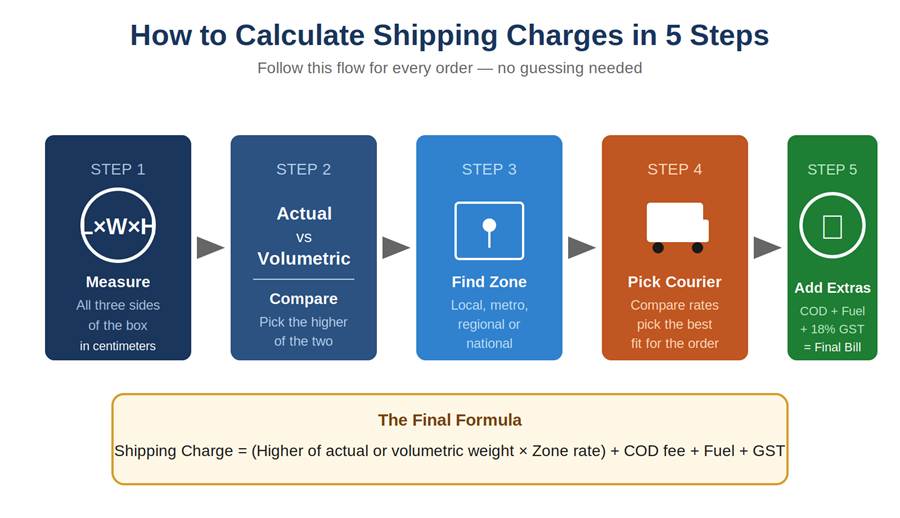
Measure Package Dimensions
Get a measuring tape. Measure the packed box (not the product inside) in centimeters. Round up to the next whole cm. A 22.4 cm side becomes 23 cm.
Calculate Weight
Weigh the packed box on a scale. Run the volumetric formula. Pick whichever number is higher. That’s your chargeable weight.
Identify Delivery Zone
Check the destination pin code against your courier’s zone chart. Local zones bill cheapest. Northeast, Jammu & Kashmir, and island regions bill highest.
Select Courier Service
Compare rates from 2-3 couriers for that weight class and zone. Don’t just look at price. Check pin code coverage, delivery time, and RTO history too. Shipra runs this comparison automatically for every order, so you stop hopping between courier portals.
Add Additional Charges
Add COD fee if it’s a cash order. Add fuel surcharge. Apply 18% GST on the subtotal. That number is your final shipping cost.
Shipping Charge Calculation Examples
Let’s calculate shipping charges with a real example. You’re shipping a 40 × 30 × 20 cm box, weighing 2 kg, from Mumbai to Bangalore.
- Volumetric weight: (40 × 30 × 20) ÷ 5000 = 4.8 kg
- Actual weight: 2 kg
- Chargeable weight: 4.8 kg (the higher one)
- Mumbai-Bangalore is a metro zone. Say courier rate is ₹35 per 500g
- Base charge: 10 slabs × ₹35 = ₹350
- Fuel surcharge: 20% of ₹350 = ₹70
- Subtotal: ₹420
- COD fee (if COD): ₹40, subtotal becomes ₹460
- GST: 18% of ₹460 = ₹83
- Final shipping cost (with COD): ₹543
If the same order is prepaid, drop the COD line and you get ₹496. This is the math couriers run on every shipment. Once you can do this in your head, product pricing becomes a lot easier.
Domestic vs International Shipping Costs
Domestic shipping in India follows the formula above. International shipping adds customs duty, import taxes, exchange rate buffer, and country-specific zone rates on top. International rates often run 5-10x higher than domestic. Most Indian sellers stick to domestic-only for the first 12-18 months before exploring exports.
How Courier Companies Calculate Shipping Fees
Every Indian courier follows the same base logic: chargeable weight × zone rate + surcharges + GST. The differences sit in the rate cards. Blue Dart charges premium for premium speed. Delhivery competes hard on volume pricing. Ecom Express handles tier-2 and tier-3 cities well. XpressBees and Shadowfax are climbing fast on price and tech.
Common Mistakes While Calculating Shipping Charges
- Ignoring volumetric weight for big light packages
- Forgetting fuel surcharge in initial estimates
- Using outdated rate cards that don’t reflect current pricing
- Not adding COD return charges to your cost model
- Picking the cheapest courier without checking pin code serviceability
Tips to Reduce Ecommerce Shipping Costs
Once you’ve got the math down, cutting costs becomes easier. The big wins:
- Switch to smaller packaging to bring down volumetric weight
- Negotiate volume-based discounts with your courier
- Work with multiple couriers and pick the cheapest one per order
- Reduce RTO by verifying addresses and confirming COD orders before dispatch
- Use a shipping automation platform like Shipra to handle rate comparison automatically
Shipping Calculator Tools for Ecommerce Businesses
Manual shipping cost calculate works fine when you ship 10-20 orders a day. Past that, you need software. Shipra’s dashboard pulls live rates from every connected courier before each shipment, picks the cheapest one based on your rules, and applies your custom logic (always use a specific courier for certain pin codes, skip a courier for high-value orders). Most sellers cut their daily shipping math time from 2-3 hours to about 15 minutes once they switch.
Importance of Shipping Automation in Cost Calculation
Calculating shipping charges by hand for every order opens the door to errors. One missed surcharge, one wrong weight class, and you’ve quoted a customer wrong. Automation closes that gap. Shipra checks the live courier rate card for each order, applies the right zone and weight class, factors in surcharges, and gives you the exact final cost. No guesswork, no end-of-month surprises.
How to Choose the Right Shipping Partner in India
Don’t pick a courier on price alone. Check these things first:
- Pin code coverage across your top delivery regions
- Average delivery time and RTO rate
- COD reconciliation speed and accuracy
- Support response time when shipments get stuck
- Volume-based discount structure as you grow
Shipra connects with all the major Indian couriers (Delhivery, Blue Dart, Ecom Express, DTDC, XpressBees, Shadowfax, and more), so you don’t have to commit to just one. You can use the right courier for the right order, picked automatically by the system.
Conclusion
Getting how to calculate shipping charges right is the foundation of profitable ecommerce in India. Get the formula right, account for volumetric weight, factor in fuel surcharge and GST, and your monthly courier invoices stop being a surprise. Apply the 5-step process for every order and your margins stay protected.
For sellers shipping 30+ orders a day, doing this math by hand stops making sense. Shipra automates the full calculate shipping charges flow, picks the cheapest courier per order, prints labels in bulk, and updates your customer with tracking. The platform pays for itself within 10-15 days for most sellers, and after that it’s just savings on top of savings.
FAQs
How are ecommerce shipping charges calculated in India?
Indian couriers use this formula: (Chargeable weight × Zone rate) + COD fee + Fuel surcharge + 18% GST. Chargeable weight is whichever is higher between actual weight and volumetric weight.
What is the formula for shipping costs?
The formula for shipping costs is: Shipping Charge = (Chargeable Weight × Zone Rate) + COD Fee + Fuel Surcharge + 18% GST. Volumetric weight is calculated as (L × W × H in cm) ÷ 5000.
What is volumetric weight in shipping?
Volumetric weight converts a package’s size into a weight value. Formula: (Length × Width × Height in cm) ÷ 5000. Couriers charge for whichever is higher between volumetric and actual weight.
What factors affect shipping costs for ecommerce businesses?
Seven factors: package weight, volumetric weight, delivery zone, courier rates, delivery speed, COD charges, and fuel surcharge plus GST.
How do courier companies calculate delivery charges?
They take the chargeable weight, multiply it by the zone rate based on destination pin code, add COD fee if applicable, add fuel surcharge, and apply 18% GST on the total.
What is the difference between dead weight and volumetric weight?
Dead weight is the actual scale weight. Volumetric weight is calculated from box dimensions. Couriers bill for whichever is higher.
Are COD charges included in shipping costs?
Yes. COD orders carry an extra ₹30-50 or 1-2% of order value, whichever is higher. This gets added to your base shipping cost.
How can ecommerce businesses reduce shipping charges?
Use smaller packaging, negotiate rates, work with multiple couriers, reduce RTO, and switch to shipping automation software like Shipra that picks the cheapest courier per order automatically.
Which is the cheapest courier service for ecommerce in India?
It depends on your zones and order volume. Delhivery and Ecom Express are competitive for high-volume sellers. Shipra’s dashboard compares all couriers per order so you don’t have to commit to just one.
Do shipping charges vary by delivery zone?
Yes, by a lot. Local delivery can be 60-70% cheaper than national or special zone shipments of the same weight.
What tools can help calculate ecommerce shipping costs?
Shipping automation platforms like Shipra compare courier rates live, calculate the chargeable weight, and pick the cheapest option for every order automatically.
#How to Calculate Shipping Charges
Related Posts
 Shipra.org vs Shipra.io: Understanding Why These Are Two Different Companies
 Top 10 Online Shopping Sites in India for Clothes (2026)
 Jewellery Wholesale Market in Delhi: A Buyer’s Guide That Actually Helps (2026)