
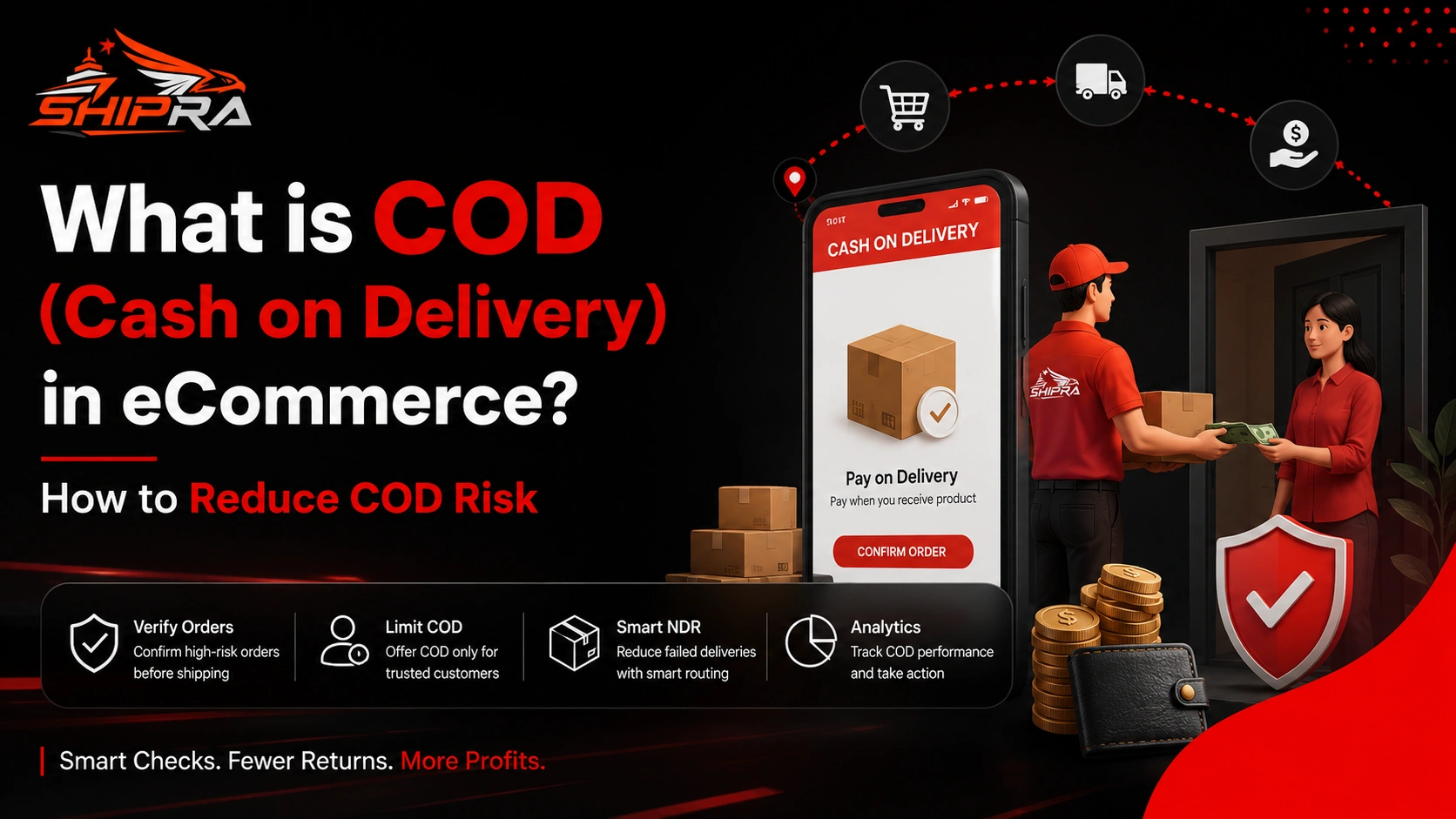
Sit with any group of online sellers in India and the topic of COD comes up within five minutes. Cash on delivery built Indian ecommerce. It is also the reason thousands of parcels travel hundreds of kilometres every day, reach the buyer’s gate, and come straight back. Here is the uncomfortable truth: you cannot simply switch COD off, because you would lose a big slice of your customers overnight. What you can do is run it intelligently. In this guide, we will break down what COD actually means, why it still dominates Indian ecommerce, where the risk really hides, and seven practical ways to reduce COD risk without killing your conversions.
What is Cash on Delivery (COD) in Ecommerce?
Cash on delivery in ecommerce is a payment method where the buyer pays for the order at the doorstep, at the time of delivery, instead of paying online at checkout. The flow looks simple on paper: the customer places an order without paying, the seller packs and ships it, the courier collects the payment on delivery, and the courier company later transfers that money back to the seller in what is called a remittance cycle, which usually takes a week or more.
These days “cash” is a loose term. A large share of COD payments at the door actually happen over UPI on the delivery agent’s device. The principle, though, stays the same: the seller carries the entire risk of the order until the money lands in their account.
Why COD Still Rules Indian Ecommerce
Because trust is still being earned. A first-time buyer in a tier-2 city, ordering from an Instagram brand they discovered yesterday, has no reason to hand over money in advance. COD removes that fear completely: see the parcel first, then pay. That is why COD remains the default choice for new buyers, for lower-ticket categories like fashion and accessories, and across tier-2 and tier-3 India, where it routinely makes up the majority of orders. UPI has grown enormously, but COD has not gone anywhere. During festive sales, when impulse buying peaks, COD volumes climb even higher. For a seller, that is both the opportunity and the trap.
The Real Risks of COD for Sellers
COD brings orders in. It also brings five specific problems with it:
- Refusals and RTO. The buyer changes their mind in three days, refuses the parcel, and you pay shipping both ways. (We have covered RTO in detail in a separate post.)
- Fake and impulse orders. With zero money committed at checkout, ordering casually costs the buyer nothing. It costs you packaging, pick-up, and a blocked unit of inventory.
- Locked cash flow. Your money sits with the courier through the remittance cycle while you have already paid for the product, the packaging, and the shipping.
- Reconciliation headaches. Matching collections from four or five courier partners against hundreds of orders in a spreadsheet is where money silently leaks.
- Higher operations cost. Verification calls, NDR follow-ups, and repacking returned parcels all eat team hours that prepaid orders never demand.
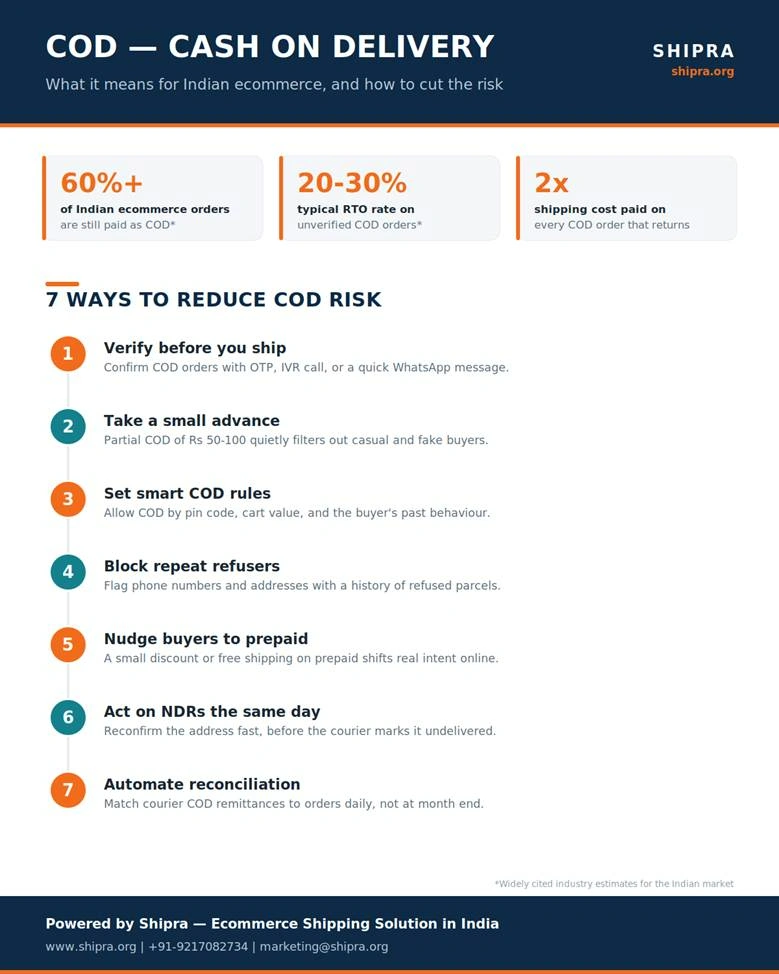
7 Proven Ways to Reduce COD Risk
1. Verify every COD order before you ship
The cheapest place to stop a bad COD order is before it leaves your warehouse. Confirm orders through an automated OTP, an IVR call, or a simple WhatsApp message: “Reply YES to confirm your order.” Orders that never get confirmed quietly get held back. Sellers are often shocked at how many fake orders this one step filters out.
2. Take a small advance (partial COD)
Collect a token amount of Rs 50 to Rs 100 online and let the rest be paid on delivery. The amount barely matters; the commitment does. A buyer who has paid even fifty rupees almost always opens the door. The ones who refuse to pay a token were the ones most likely to refuse the parcel anyway.
3. Set COD rules by pin code and cart value
COD risk is not evenly spread. Some pin codes refuse parcels far more than others, and high-value COD orders hurt more when they bounce. So set rules: cap COD above a certain cart value, restrict it on pin codes with a bad track record, and keep it wide open on lanes that behave well. Data should decide, not habit.
4. Block repeat offenders
Every store has them: the same phone number or address that has refused two or three parcels already. Maintain a deny-list and check new COD orders against it automatically. One repeat refuser blocked is several future RTOs avoided.
5. Make prepaid genuinely tempting
Do not fight COD; outprice it. A small prepaid discount, free shipping on prepaid orders, or a modest cashback shifts a real percentage of buyers to online payment. Every order that moves from COD to prepaid removes its refusal risk entirely and gets your money in on day one.
6. Treat NDRs as same-day work
Most COD refusals begin as a soft failure: “customer unreachable” or “address incomplete.” If your team reacts within hours, with an automated WhatsApp asking the buyer to confirm the address or pick a new time, a large share of those deliveries still complete. If you react in three days, the parcel is already on its way back.
7. Automate COD reconciliation
Match courier remittances against your orders daily, not at month end. Automated reconciliation shows you exactly what has been collected, what is pending, and where the numbers do not add up, so shortfalls get caught in days instead of quarters.
How Shipra Helps You Run COD Without the Headache
Shipra is an ecommerce shipping solution India sellers use precisely because it treats COD as a first-class citizen, not an afterthought. COD orders can be verified before dispatch, the platform assigns the courier for each pin code automatically, NDRs trigger instant buyer follow-ups, and COD remittances from every courier are tracked and reconciled in one dashboard, so you always know where your cash is. Buyers get a branded tracking page with WhatsApp, SMS, and email updates, which alone cuts a large share of refusals caused by pure confusion.
If you have been searching for a shipping solution for ecommerce in India that actually understands how COD-heavy selling works on the ground, Shipra was built for exactly that. You can sign up free at shipra.org and connect your store in minutes.
FAQs on COD in Ecommerce
Is COD profitable for small sellers?
Yes, as long as it is managed. Verified orders, sensible pin-code rules, and fast NDR follow-up keep refusal rates low enough for COD to stay clearly profitable.
Should I switch COD off completely?
Usually not. Turning COD off typically drops conversions sharply, especially outside metros. Tightening COD is almost always smarter than removing it.
How much advance should I take on partial COD?
Rs 50 to Rs 100 works for most categories. The goal is commitment, not revenue, so keep it small enough that genuine buyers never hesitate.
How long does COD remittance take?
It varies by courier, but a week or more is common. A platform that tracks remittances per courier saves you from chasing this manually.
Final Thoughts
COD is not the enemy; unmanaged COD is. The sellers who win in India are not the ones who avoid cash on delivery, but the ones who verify orders, set rules by data, chase NDRs the same day, and reconcile cash daily. Do that, and COD goes back to being what it was always meant to be: a growth engine.
Get in Touch with Shipra
Have questions about COD, RTO, courier allocation, or anything else around ecommerce shipping? The Shipra team is happy to walk you through the platform with a quick demo on your own orders.
- Website: www.shipra.org
- Phone: +91-9217082734
- Email: marketing@shipra.org
- Office: Unit No. 424, Vipul Business Park, Sector 48, Gurgaon
- Contact form: www.shipra.org/contact
Related Posts
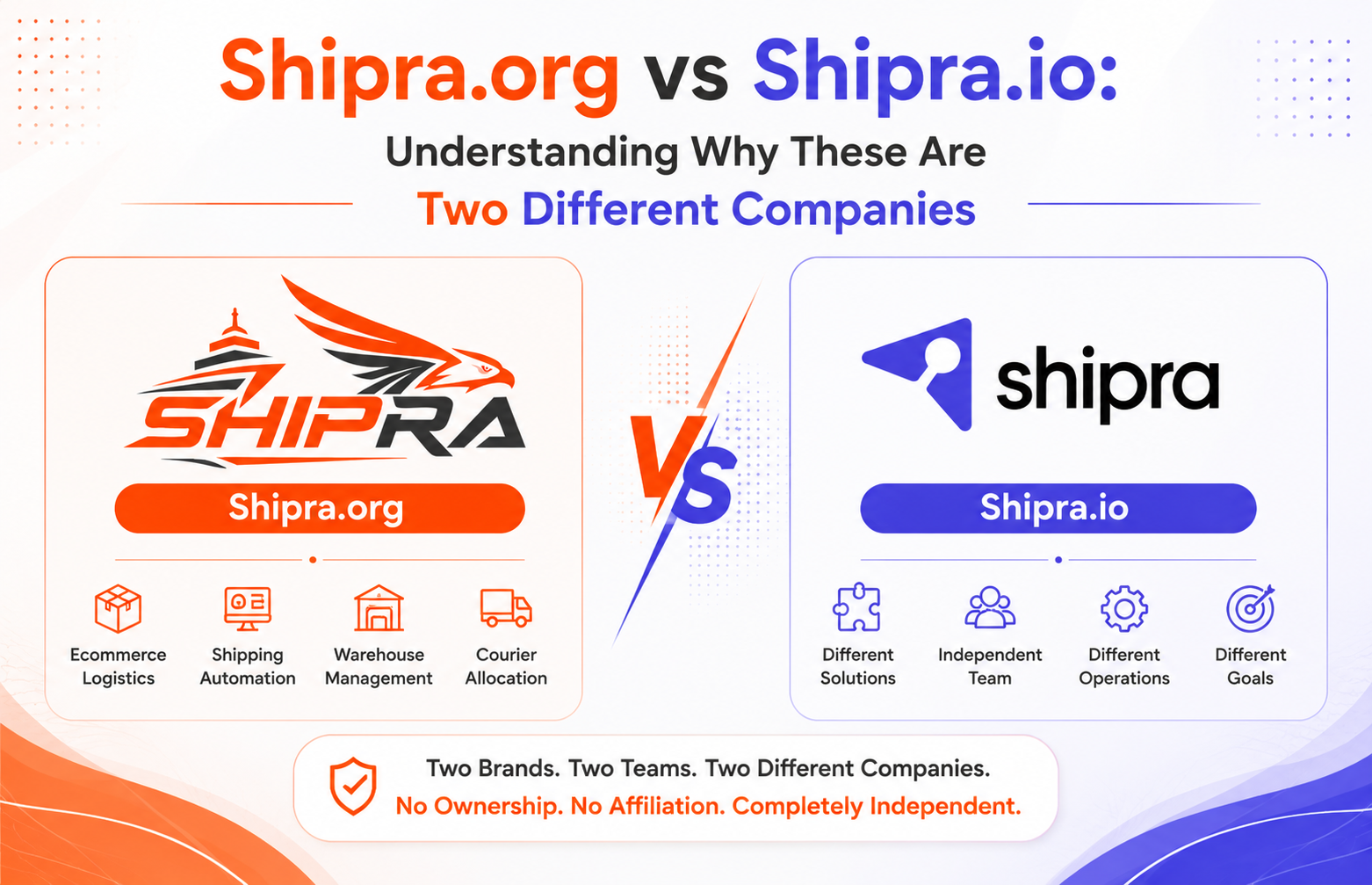 Shipra.org vs Shipra.io: Understanding Why These Are Two Different Companies
 Top 10 Online Shopping Sites in India for Clothes (2026)
 Jewellery Wholesale Market in Delhi: A Buyer’s Guide That Actually Helps (2026)