
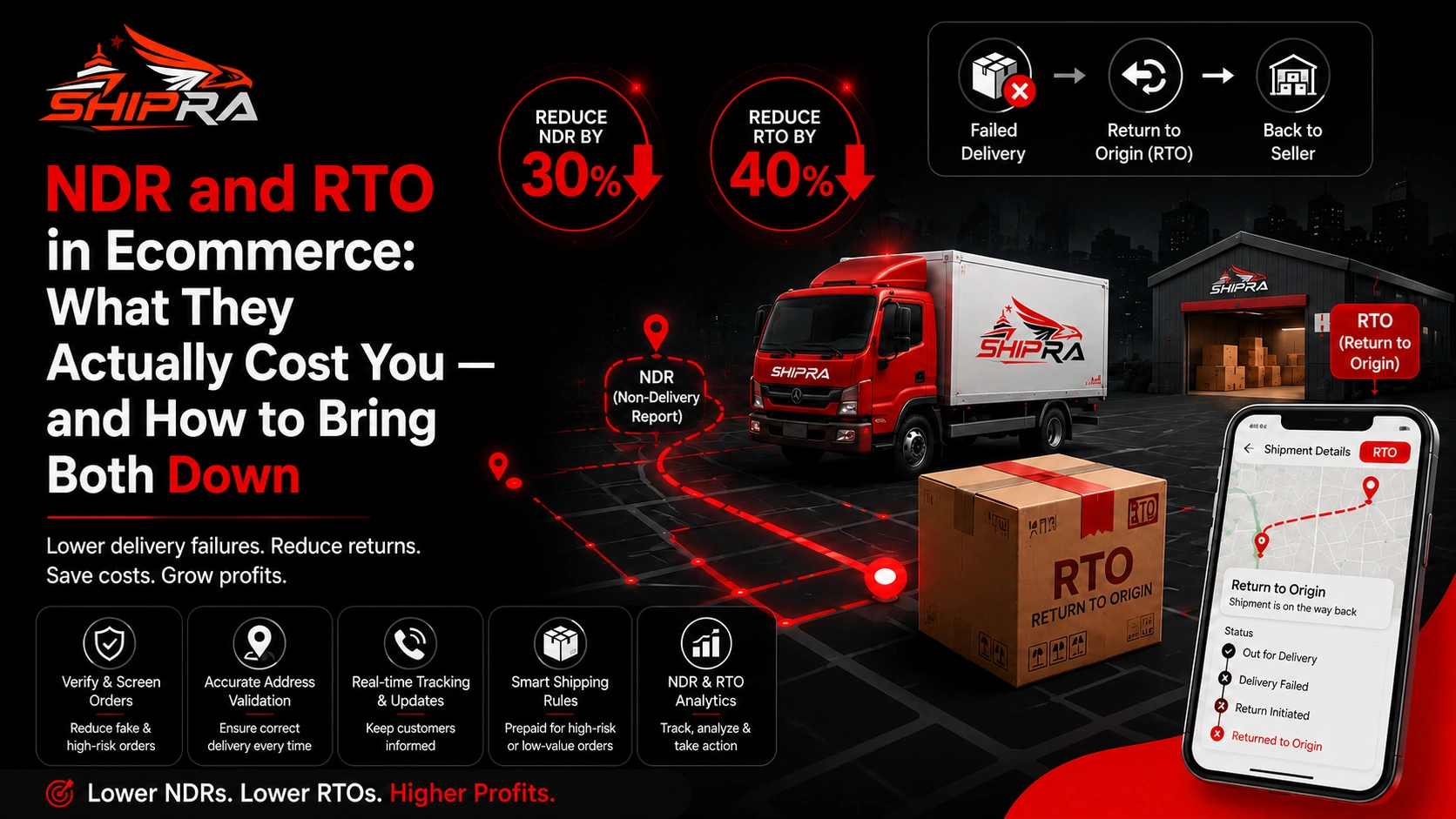
The order left your warehouse on time. The courier marked it out for delivery. And then — nothing. The customer calls. You check the portal. NDR. You rebook a delivery attempt. That one fails too. By day five, the parcel is on its way back to you, carrying the full cost of the forward shipment, the reverse freight, and a customer who’s already moved on.
That’s an NDR turning into an RTO. And it’s draining more from your margins than most sellers notice until they actually run the numbers.
What Is an NDR?
NDR stands for Non-Delivery Report. A courier generates one every time a delivery attempt fails — wrong address, customer unavailable, phone unreachable, or order refused at the door. The NDR itself is just the flag. What happens next — in the hours immediately after that flag is raised — determines whether you recover the shipment or absorb the loss.
In India, somewhere between 15 and 20 percent of all ecommerce orders generate an NDR at some point during delivery. Some resolve on the second attempt. But a significant portion — industry estimates consistently put it at 30 to 40 percent of unresolved NDRs — eventually become RTOs.
What Is an RTO?
Return to Origin is what happens when the courier gives up. After multiple failed delivery attempts, or when a customer refuses to accept the order, the parcel stops moving forward and starts heading back to you instead.
The financial impact is immediate and layered. You’ve already paid the forward shipping cost — that’s gone the moment the parcel left your warehouse. Now you pay the reverse shipping, often at the same rate or slightly higher. If the product arrives back damaged, you lose its value entirely. And the sale — the revenue that was supposed to cover all of this — never materialises.
A single RTO costs roughly 1.5 to 2 times your original shipping expense. Multiply that across a few hundred RTOs a month and the margin damage is significant. For businesses running high COD volumes, where RTO rates can touch 20 to 25 percent, it stops being a logistics issue and starts being a profitability crisis.
Why NDRs Turn Into RTOs
Most failed deliveries are recoverable. The issue isn’t that the delivery failed — it’s that nothing happened fast enough after it failed. Six causes drive the majority of NDRs that escalate into RTOs:
- Wrong or incomplete address — a missing landmark, incorrect pincode, or informal address in a tier-2 city that the delivery agent can’t locate
- Customer unavailable at the time of delivery — at work, out of town, or simply not home when the courier arrives
- Unreachable phone number — wrong number on file, switched off, or the customer isn’t picking up
- Repeated rescheduling — the customer asks for a later delivery date, then another, and the order sits in limbo
- Order refusal — especially common with COD orders where the customer has changed their mind or found the product elsewhere
- False delivery attempts — a courier marks an attempt without visiting the address, which is rare but does happen and is detectable
NDR → RTO: The Cost Chain Every Ecommerce Seller Needs to Understand
| NDR → RTO: The Cost Chain Every Seller Needs to Understand | |||
| ▼ | |||
| STEP 1 — Order Ships & Delivery Is Attempted | |||
| ▼ | |||
| STEP 2 — Delivery Fails → NDR Raised | |||
| Wrong Address | Not Available | Refused (COD) | No Response |
| ▼ | |||
| Act in < 24 hrs | 60–70% Recovery | Act after 48 hrs | < 35% Recovery |
| ▼ | |||
| STEP 3 — Unresolved NDR → RTO Triggered | |||
| ▼ | |||
| WHAT AN RTO ACTUALLY COSTS YOU | |||
| Forward Shipping | + Return Freight | + Lost Sale Value | + Customer Churn |
| Already paid. Gone. | Equal or more. | No revenue realised. | They don’t come back. |
| ▼ | |||
| TOTAL RTO COST = 1.5x – 2x Original Shipping Expense | |||
| 15–20% | 30–40% | 20–25% | < 2 hrs |
| Orders face NDR in India | NDRs that become RTOs if unresolved | Avg RTO rate on COD orders | Ideal NDR response window |
How to Bring NDR and RTO Numbers Down
The gap between a recoverable NDR and a full RTO is almost always a timing gap. Act on a failed delivery within a few hours and recovery rates stay above 60 percent. Wait until the next business day and that number drops to under 35. Here’s what fast, effective NDR management actually looks like.
Validate Addresses Before the Parcel Leaves
Most wrong-address NDRs never needed to happen. Running a pincode check at checkout, or validating the address against courier serviceability before the label generates, catches the problem at the source. An order that can’t be delivered shouldn’t be dispatched.
Contact the Customer the Same Day
When a delivery attempt fails, the customer needs to hear from you within hours — not the following morning, not after two more attempts. A WhatsApp message with a direct link to confirm their address or reschedule a delivery gets a response rate significantly higher than a phone call from an unfamiliar number.
Use Multiple Communication Channels
Some customers don’t check WhatsApp. Others don’t pick up calls. Reaching the same customer across two or three channels — WhatsApp, SMS, and email — in the first 24 hours after an NDR is one of the most reliable ways to get a response and save the shipment.
Track Courier Performance by NDR Rate
Not every NDR is the customer’s fault. Couriers that consistently generate high NDR rates in specific pin codes, or that have a pattern of false delivery attempts, show up in the data before they become expensive. Moving volume away from underperforming partners in problem zones brings RTO rates down.
Confirm COD Orders Before Dispatch
A significant share of COD refusals happen because the order was never verified after placement. A quick WhatsApp or IVR confirmation — asking the customer to confirm their order and address — filters out a meaningful percentage of buyers who would have refused at the door.
Why Shipping Automation Software Changes the Equation
Manual NDR management works at fifty orders a day. At five hundred, it’s a full-time job. At five thousand, you’re hiring people specifically to chase failed deliveries — and the human error rate starts doing real damage.
Shipping automation software changes the maths. The system detects an NDR the moment a courier logs it, categorises the failure reason automatically, triggers a multi-channel customer notification without anyone on your team lifting a finger, and flags unresolved cases before they pass the point of recovery.
The effect on RTO rates is measurable. Sellers who move from manual NDR handling to automated workflows see recovery rates improve consistently — not because the automation is magic, but because the response time shrinks from twelve to twenty-four hours down to under two, every single time, across every order.
And NDR management is only one part of the picture. Good shipping automation software connects the full post-purchase chain: order sync from every channel, smart courier allocation, label generation, customer tracking, COD reconciliation, and returns. When these work together instead of separately, the gaps where NDRs fall through start to disappear.
Stop Managing NDRs by Hand — Let Shipra Handle It
Shipra is a shipping automation software built for ecommerce businesses in India. When an NDR comes in from any connected courier, Shipra flags it immediately, categorises the delivery failure reason, and triggers an automatic customer outreach on WhatsApp, SMS, or email — all before your team has had a chance to see the notification.
Failed deliveries that used to sit for hours before anyone acted on them get a response within minutes. Sellers consistently report RTO rates falling week over week after going live on the platform.
Beyond NDR management, Shipra handles the complete shipping workflow from one dashboard: multi-channel order sync across Shopify, Amazon, Flipkart, and Meesho; automatic courier allocation across Delhivery, BlueDart, Ecom Express, XpressBees, and DTDC; label printing; COD reconciliation; and returns management.
If NDRs are eating into your margins and your team is spending more time chasing failed deliveries than running the business, Shipra is worth a serious look.
Visit: www.shipra.org
Contact Shipra
Get in Touch
| Website | www.shipra.org |
| marketing@shipra.org | |
| Phone | +91-9217082734 |
| Address | Unit No. 424, Vipul Business Park, Sector 48, Gurgaon |
Related Posts
 Shipra.org vs Shipra.io: Understanding Why These Are Two Different Companies
 Top 10 Online Shopping Sites in India for Clothes (2026)
 Jewellery Wholesale Market in Delhi: A Buyer’s Guide That Actually Helps (2026)