
Shipping costs eat into Indian ecommerce margins more than any other expense. If you’ve been wondering how to reduce shipping costs without cutting delivery quality or making customers unhappy, this guide covers 10 tested methods. Some you can apply today. Others take a few weeks to set up. All of them work, and most sellers who try 3-4 of them see 20-30% lower shipping bills within 60 days.
The shipping cost saving tips below come from watching thousands of Indian sellers run their shipping through Shipra’s dashboard over the past few years. The patterns are consistent: sellers who switch from manual to automated workflows save the most, fastest.
Why Shipping Costs Matter in Ecommerce
For most Indian online businesses, shipping is the second-biggest expense after product cost. A typical order has 12-18% of its value going into logistics: courier fees, packaging, RTO losses, reverse pickups. If your margin is 30%, that means almost half your profit is sitting in the shipping line item, often quietly eaten by inefficiencies you didn’t notice.
Trim shipping cost by 15% on an order with 30% margin and your net profit jumps roughly 7 percentage points. That’s the difference between scaling and struggling. Strong shipping cost management is not optional in Indian ecommerce. It’s the lever most sellers don’t pull hard enough.
Common Reasons for High Shipping Costs
Before you can lower shipping costs, find out where the money is actually going.
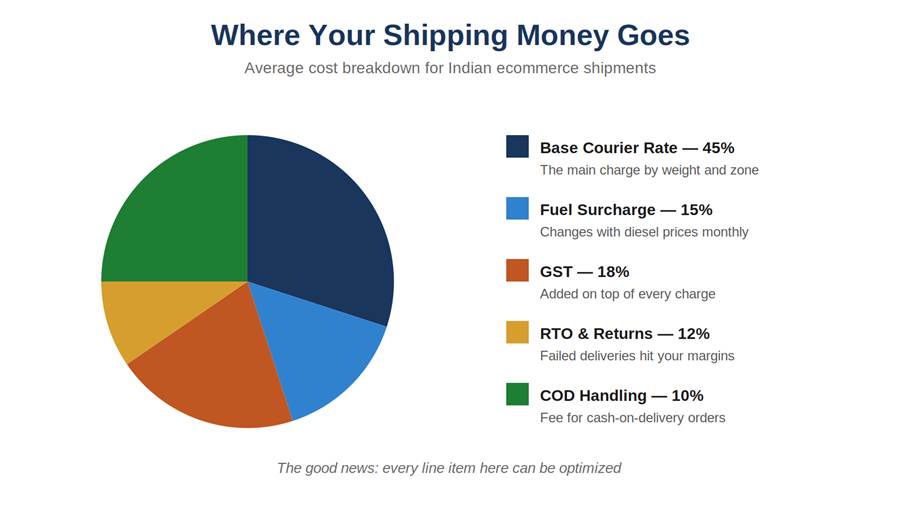
- Paying the same courier for every order regardless of cost
- Using oversized boxes that inflate volumetric weight
- High RTO rates from unverified addresses
- Not negotiating rates even after volume grows
- Missing fuel surcharge and GST in initial price estimates
- Ignoring regional warehousing for long-distance shipments
Most sellers don’t have a clear picture of these costs until they review three months of courier invoices side by side. Once you see the numbers, the fixes get obvious.
Analyze Your Current Shipping Expenses First
You cannot reduce what you do not measure. Pull your last 90 days of courier invoices and calculate these numbers:
- Average cost per shipment
- RTO rate (percentage of orders coming back)
- Percentage of COD orders
- Share of volume across each courier
- Cost per shipping zone
Most sellers find at least 1-2 surprises in there. Maybe one courier is overcharging by 30% on certain routes. Maybe RTO is silently costing ₹40,000 a month and nobody flagged it. Once the data is on the table, prioritizing the next 10 fixes gets easier.
Tips to Reduce Shipping Costs for Your Ecommerce Business
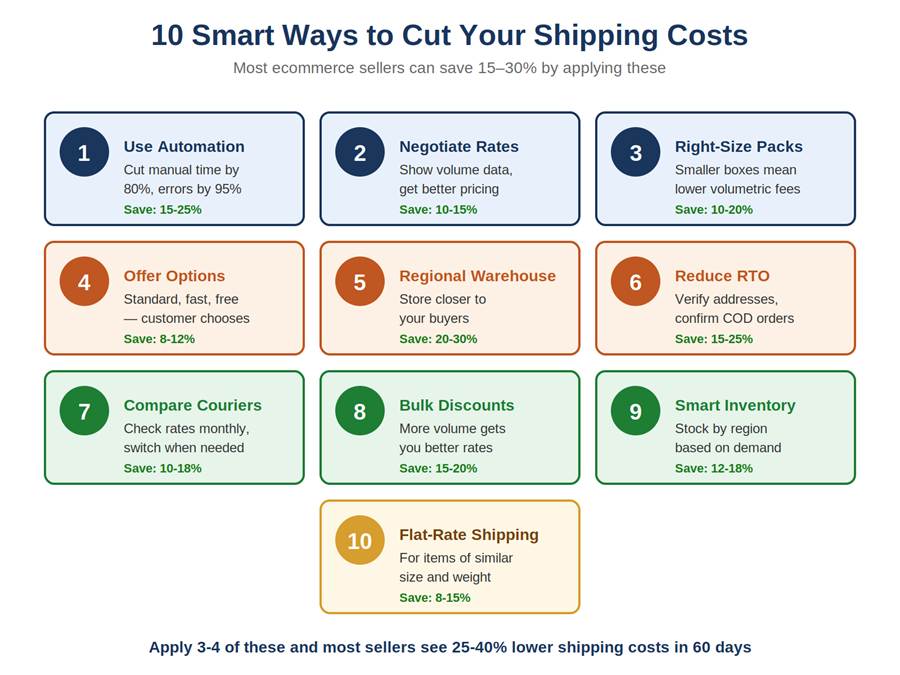
1. Use Shipping Automation Software
This is the single biggest win. Shipping automation software like Shipra compares rates across all your couriers in real time and picks the cheapest option for every order automatically. Manual processes default to the same courier for everything and overpay on 60-70% of shipments. Automation also cuts manual labor by 80% and brings error rates near zero. Most sellers who switch to Shipra see shipping costs drop 15-25% in the first month, just from smarter courier routing.
2. Negotiate Better Rates with Courier Partners
Couriers want volume. If you ship 200+ orders a month, you have leverage. Most sellers don’t use it. Pull your last 90 days of shipping data, show your courier the volume and pin code mix, and ask for a custom rate card. Even a 10% rate improvement adds up fast. If your current courier doesn’t move, get competing quotes. They usually move after that.
3. Optimize Packaging to Reduce Dimensional Weight
Couriers bill for whichever is higher between actual weight and volumetric weight. Volumetric weight is calculated as (Length × Width × Height in cm) ÷ 5000. A 40×30×20 cm box has 4.8 kg volumetric weight even if the product inside weighs 1 kg. Right-size your packaging. Use boxes that fit your products. Switch heavy items to padded mailers where safe. Most sellers save 10-20% on shipping by fixing packaging alone.
4. Offer Multiple Shipping Options to Customers
Don’t push one shipping method on every customer. Offer free standard (slowest, cheapest courier), paid express (faster, costs more), and free above a certain order value. Customers self-select. Most pick the slowest free option, which means you ship via your cheapest courier and they’re still happy. This reduces the pressure to absorb fast-shipping costs on every order.
5. Use Regional Warehouses or Fulfillment Centers
If 40% of your orders go to South India and your warehouse sits in Delhi, you’re paying long-zone rates on almost half your shipments. Splitting inventory across 2-3 regional warehouses (Delhi-Bangalore-Mumbai is a common setup) turns most shipments into local or regional shipments, which cost 30-50% less than national. This makes the most sense once you cross 1,000 orders a month.
6. Reduce RTO and Return Shipping Costs
RTO (Return to Origin) is a silent margin killer. Every RTO costs you forward shipping, reverse shipping, packaging, and sometimes the product itself. A 20% RTO rate on COD orders can wipe out 8-10% of your revenue. Fix it by verifying addresses at checkout, confirming COD orders before dispatch, blocking risky pin codes, and using OTP-based delivery for high-value items. Shipra tracks RTO patterns automatically and flags risky pin codes based on your historical data, which is one of the practical shipping cost saving tips that gets ignored too often.
7. Compare Multiple Courier Services Regularly
Courier rates change. Fuel surcharges shift monthly. Service quality in specific zones moves around. Review your courier mix every 60-90 days. Most sellers stick with the same courier out of habit and miss 10-15% savings sitting in plain sight. A platform like Shipra runs this comparison automatically for every shipment, so the savings happen without you actively managing it.
8. Leverage Bulk Shipping Discounts
If you ship consistent monthly volume, ask your courier for tiered pricing. Many couriers offer 5-15% volume discounts but only give them when asked. Consolidating 70% of your volume with one courier can unlock better rates on that block, while you keep a backup courier for difficult zones. This is one of the easiest ways to lower shipping costs without changing anything else about your operations.
9. Implement Smart Inventory Management
Stock the right products in the right warehouses. If your top-selling South India SKUs are sitting in your Delhi warehouse, every order ships long-zone. Use your sales data to forecast regional demand and rebalance inventory accordingly. This pairs with point 5: regional warehousing only saves money if the right stock is in the right place.
10. Use Flat-Rate Shipping for Suitable Products
For products with similar size and weight, flat-rate shipping makes pricing simple and often cheaper. Couriers offer flat-rate boxes where you pay one rate regardless of weight up to a limit. Works great for apparel, accessories, small electronics, and books. Customers also appreciate the price clarity at checkout, which can help conversion rates.
Bonus Shipping Cost Saving Tips
- Print labels in bulk to save courier portal time
- Schedule pickups instead of paying for individual visits
- Buy packaging materials in bulk every quarter
- Train your packing team to pick the smallest viable box
- Audit shipping invoices monthly to catch billing errors
Common Mistakes Businesses Make While Reducing Shipping Costs
Some shortcuts cost more than they save. Watch out for these:
- Picking the cheapest courier without checking pin code reliability
- Using under-packed boxes that lead to damage and replacements
- Cutting customer communication — RTO goes up when buyers don’t get tracking
- Switching couriers too often without giving the relationship time to settle
- Focusing only on rate while ignoring RTO and damage costs
Tools for Shipping Cost Optimization
The right tools turn these 10 strategies into actual savings. Look for tools with multi-courier rate comparison, pin code serviceability checks, RTO prediction from historical data, COD reconciliation across couriers, and real-time shipping analytics. Stitching together 4 separate tools is more work than just using one connected platform.
Shipra combines all of these in a single dashboard. Over 420K Indian businesses use Shipra as their primary shipping automation software. The platform is built specifically for Indian ecommerce, which is why it handles things international tools struggle with: COD reconciliation, regional courier integrations, marketplace sync, GST-compliant invoicing, and pin code-level analytics. For sellers serious about shipping cost management, Shipra is the closest thing to an all-in-one solution available right now.
Benefits of Lower Shipping Costs for Ecommerce Businesses
Cutting shipping costs does more than improve margins. It changes what’s possible for your business:
- Offer free shipping, which lifts conversion rates 15-30%
- Invest more in customer acquisition
- Run sharper promotions without hurting margins
- Protect profit during slow seasons
- Build pricing flexibility for competitive product categories
Sellers who get shipping costs under control gain a real edge. They can price competitively without bleeding margin every order.
Future Trends in Ecommerce Shipping Optimization
Indian ecommerce shipping is changing fast. AI-based courier selection, dark stores in tier-2 and tier-3 cities, drone delivery trials in select regions, tighter integration between marketplaces and logistics platforms. Sellers who automate now and build flexible logistics setups adapt much faster than sellers still stuck on manual processes. The gap between automated and manual sellers will only widen over the next 2-3 years.
Conclusion
Knowing how to reduce shipping costs is one of the highest-leverage skills for any Indian ecommerce business. Start with the basics: measure your spending, fix your packaging, negotiate your rates, switch to automation. Apply 3 or 4 of these 10 methods over the next 60 days and most businesses see 20-30% lower shipping costs without any drop in delivery quality.
For sellers running 30+ orders a day, the fastest way to apply most of these methods at once is to switch to shipping automation software like Shipra. Rate comparison, RTO analytics, COD reconciliation, and multi-courier management happen automatically. Once Shipra is set up, shipping cost management stops being a daily headache and becomes a background process that saves you money every single shipment.
FAQs
How can ecommerce businesses reduce shipping costs?
Use shipping automation, negotiate rates with couriers, optimize packaging, reduce RTO through address verification, use regional warehouses, and compare couriers regularly. Apply 3-4 of these methods and save 20-30% on shipping bills.
What is the cheapest shipping method for online stores?
There is no single cheapest method. The cheapest courier varies by destination zone, weight, and order value. Shipra’s shipping automation software finds the cheapest option for every single order automatically.
Does shipping automation help lower logistics costs?
Yes. Automation cuts shipping costs 15-25% on average. It compares rates across all your couriers in real time and assigns the cheapest viable option per order, which manual processes simply cannot match.
How can packaging reduce shipping expenses?
Smaller boxes have lower volumetric weight, which is what couriers charge for. Right-sizing your packaging saves 10-20% on shipping. Use boxes that fit your products, not your shelves.
Why are shipping costs increasing in ecommerce?
Fuel surcharges, fixed 18% GST, growing last-mile complexity, and higher delivery expectations all push costs up. The fix is operational efficiency: better courier selection, smarter packaging, lower RTO rates.
What are the ways to reduce return shipping costs?
Verify customer addresses at checkout, confirm COD orders before dispatch, block risky pin codes with high RTO history, use OTP delivery for high-value orders, and provide clear product photos and descriptions to reduce buyer regret.
How do fulfillment centers help save shipping costs?
Regional fulfillment centers move inventory closer to customers, which turns long-zone shipments into local-zone shipments. This cuts 30-50% off shipping for orders that would otherwise travel across India.
Can small ecommerce businesses negotiate courier rates?
Yes. Even at 100-200 orders a month, you have negotiating room. Show couriers your volume and pin code mix, ask for tiered pricing, and get competing quotes. Most couriers move 10-15% on rate when asked.
What tools help optimize shipping costs?
Shipping automation platforms like Shipra compare courier rates, predict RTO, manage COD reconciliation, and give real-time shipping analytics in one dashboard.
How does inventory management reduce delivery expenses?
Smart inventory placement keeps top-selling products in the warehouses closest to where they actually sell. This reduces average shipping distance per order and cuts both delivery cost and delivery time.
Related Posts
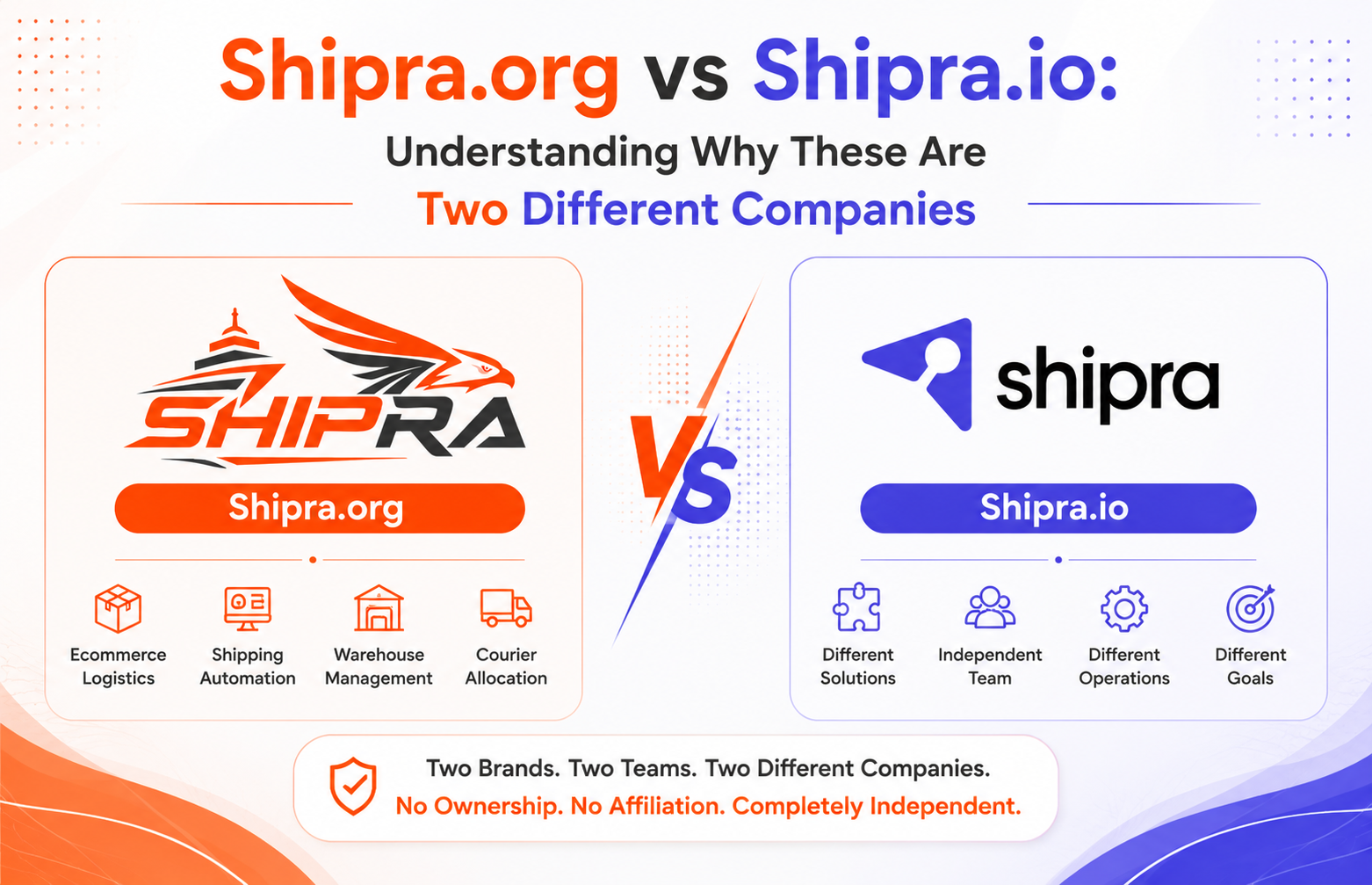 Shipra.org vs Shipra.io: Understanding Why These Are Two Different Companies
 Top 10 Online Shopping Sites in India for Clothes (2026)
 Jewellery Wholesale Market in Delhi: A Buyer’s Guide That Actually Helps (2026)