
Most Indian ecommerce businesses run on one of two systems. Either pure manual processes, or some half-built spreadsheet setup that breaks the moment volume crosses 100 orders a day. If either sounds familiar, this post will walk you through what is shipping automation, how it actually works in practice, and the real benefits of automated order fulfillment for any ecommerce shipping solutions setup in India.
Shipra has helped over 420K Indian businesses move from manual chaos to automated dispatch. The patterns in this guide come from watching what works for sellers across D2C, marketplaces, B2B, and small businesses that started on Instagram and grew into proper online stores.
What is Shipping Automation?
Shipping automation is software that takes over the repetitive parts of order fulfillment so your team doesn’t have to. The system pulls orders from your sales channels, picks the right courier for each shipment, prints labels in bulk, sends tracking SMS to customers, and updates your dashboard when packages get delivered.
Your team’s only job in the flow: pack the box and hand it to the courier. Everything else runs in the background, with zero clicks from you.
How Shipping Automation Works
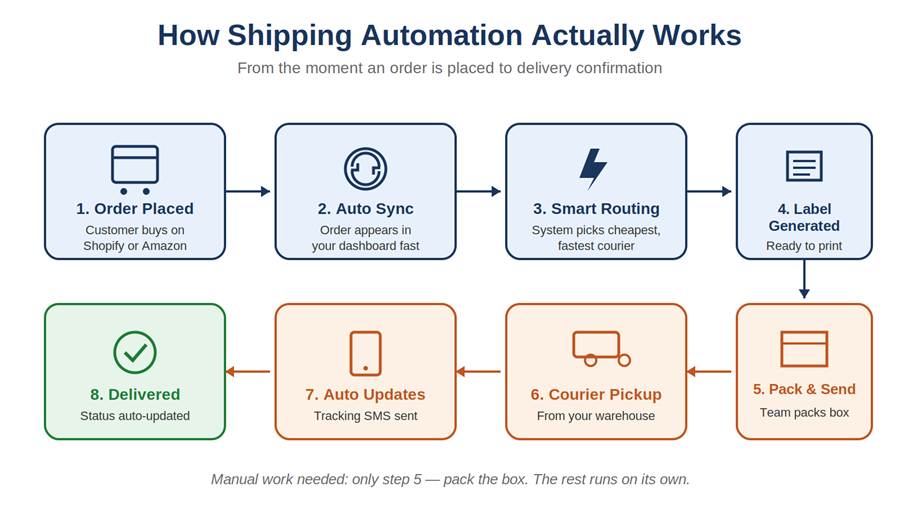
Here’s what happens behind the scenes the moment an order comes in. A customer places an order on your Shopify, Amazon, Flipkart, or WooCommerce store. Within seconds, the order syncs into your shipping platform. The system checks every connected courier for live rates and pin code serviceability. It picks the fit based on your rules (cheapest, fastest, or a specific courier for specific regions). The label generates and queues for printing. The customer gets a confirmation SMS with a tracking link. Your team prints labels in batches, packs the orders, hands them to the courier. Tracking updates flow back. Delivery confirmation closes the order.
Types of Shipping Automation Solutions
Different tools cover different parts of the flow:
- Order management systems sync orders from multiple sales channels into one place
- Courier aggregators compare rates across couriers and pick the cheapest
- Label generators create shipping labels in bulk
- End-to-end shipping platforms (like Shipra) handle the full flow from order sync to returns
If you’re juggling three separate tools and trying to make them talk to each other, you’re solving the wrong problem. A connected platform like Shipra removes the integration headache by covering everything in one account.
Importance of Shipping Automation for Ecommerce Businesses
Manual order processing eats your team’s day. A small operations team handling 200 orders manually spends 4-5 hours just on the order-to-dispatch flow. That’s 100+ hours a month. At ₹250 per hour (loaded cost of a typical ops executive), that’s ₹25,000 going into copy-paste work every month.
Shipping automation drops that to under 1 hour a day. Your team gets time back. Orders go out faster. Customers stop calling to ask where their package is, because they already got the tracking SMS the moment it shipped.
Key Features of Automated Order Fulfillment
Good shipping automation software should have all of these:
- Multi-channel order sync (Shopify, Amazon, Flipkart, Meesho, WooCommerce)
- Smart courier allocation based on rate, speed, and pin code coverage
- Bulk label printing in one click
- Automatic tracking updates to customers via SMS and email
- COD reconciliation across multiple couriers
- Return management with automated reverse pickup
- Real-time dashboard showing every order and shipment
- Rule-based workflows for specific scenarios (high-value orders, fragile items, certain regions)
Shipra covers every feature on this list inside one dashboard. Most sellers find onboarding takes a day, not a quarter.
Benefits of Automated Order Fulfillment
Here are the five biggest benefits of automated order fulfillment, with the numbers Shipra users see in their first 60-90 days:
1. Saves Hours Every Day
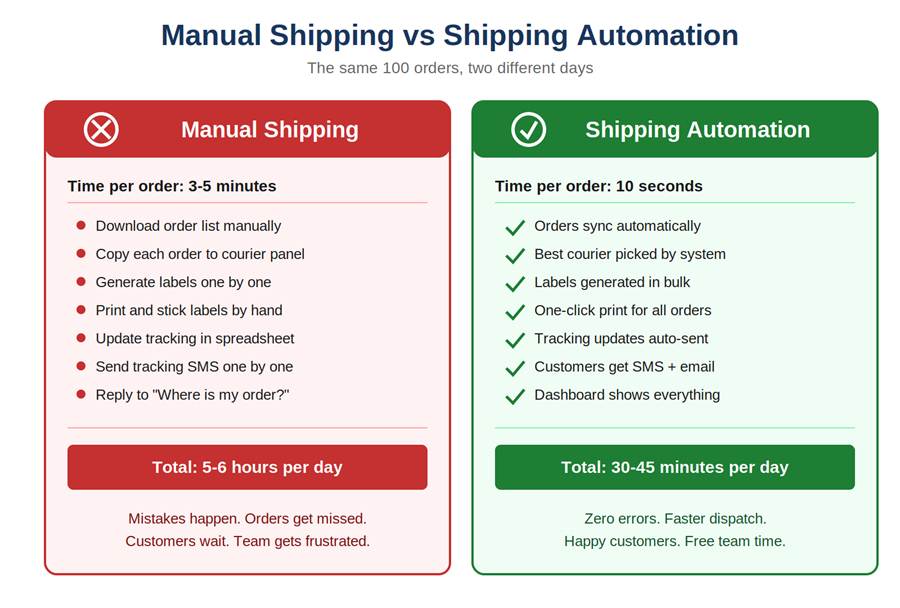
Manual order processing takes 3-5 minutes per order. Automation drops that to under 10 seconds. For a business shipping 300 orders a day, that’s 15 hours of work saved daily. This is how automation saves time in logistics at the operational level.
2. Cuts Shipping Costs by 15-25%
Smart courier selection routes every order through its cheapest viable option. Manual processes default to the same courier for everything and overpay on 60-70% of shipments. Sellers on Shipra cut their shipping bills by 15-25% on average within the first month.
3. Almost Zero Errors
Manual entry creates wrong addresses, missed orders, duplicate shipments. Automation pulls data directly from the source, so errors drop 90% or more. Customer support tickets about wrong deliveries fall right after.
4. Better Customer Experience
Customers get instant order confirmation, tracking SMS, and delivery updates without anyone touching a phone. Support tickets about order status drop 40-50% within weeks of going live.
5. Easy to Scale
Going from 100 orders a day to 1,000 isn’t a big change for an automated system. Same workflow, more volume. No need to hire 5 more people. This is one of the quieter benefits of automated order fulfillment that gets obvious only when you start growing fast.
How Automation Saves Time in Logistics
Where do all those hours actually come back? Here’s a breakdown for a business shipping around 200 orders a day:
- Order sync: 45 minutes daily → 0 minutes (auto-sync)
- Courier selection: 60 minutes daily → 0 minutes (auto-assigned)
- Label printing: 90 minutes daily → 15 minutes (bulk print)
- Tracking updates: 60 minutes daily → 0 minutes (auto-sent)
- COD reconciliation: 4 hours weekly → 30 minutes weekly (auto-reconciled)
- Customer support: 2 hours daily → 1 hour daily (fewer tracking queries)
Total work eliminated for a 200-order-per-day business: roughly 25-30 hours every week. That’s almost a full-time employee, freed up to do something that actually grows the business.
Challenges of Manual Shipping and Fulfillment
Manual shipping has hidden costs that surface everywhere:
- Operations staff burnout from repetitive work
- Wrong addresses leading to RTO and customer complaints
- Missing orders during peak sale days
- Late dispatches because someone forgot to book the shipment
- COD reconciliation errors costing thousands every month
- Customer support time eaten by ‘where is my order’ calls
Every one of these issues disappears the moment a platform like Shipra takes over the flow.
Step-by-Step Automated Order Fulfillment Process
Here’s the full automated flow, end to end:
- Customer places order on your storefront
- Order syncs to your shipping platform within seconds
- System checks all connected couriers for rate and serviceability
- Courier gets assigned automatically
- Shipping label generates and queues for printing
- Customer receives order confirmation and tracking link
- Your team prints labels in bulk and packs orders
- Courier picks up packages from your warehouse
- Tracking updates flow back to customer automatically
- Delivery confirmation closes the order in your dashboard
Manual touches needed: one. Pack the box.
How to Choose the Right Shipping Automation Software
Before signing up for any platform, run through this checklist:
- Does it integrate with the sales channels you actually use?
- Does it support the couriers you already work with?
- Can it handle your current volume, and 5x growth from here?
- Does it support COD reconciliation? (Most Indian businesses need this.)
- How fast is onboarding? You should be live in a day, not a month.
- What does support look like when something breaks at 11pm on a Saturday?
- Is pricing transparent or hidden in tiered subscriptions?
Shipra answers all of these. Onboarding takes a day. Integrations work out of the box with Shopify, Amazon, Flipkart, WooCommerce, Meesho, and more. COD reconciliation runs automatically across all your couriers. Support picks up most queries within a few hours on working days.
Shipping Automation Tools for Ecommerce
Shipra is purpose-built for Indian ecommerce, which matters more than it sounds. International tools handle generic shipping flows. They struggle with the things that actually matter here: COD reconciliation, regional courier integrations, Indian marketplace sync, GST-compliant invoicing, pin code-level serviceability checks, RTO patterns specific to certain regions. Shipra handles all of these natively because it was built for sellers shipping inside India.
Shipping Automation Costs and ROI
Most platforms charge per shipment or as a flat monthly subscription. For a business shipping 500 orders monthly, costs typically run between ₹3,000 and ₹8,000 per month. The savings? Most sellers recover that within the first 10 days through cheaper courier selection alone. Add the 20-30 hours of weekly time saved and the math is one-sided fast.
Shipping Automation vs Manual Fulfillment
Manual works at 10-15 orders a day. Past that, the math breaks. Your team starts missing orders. Mistakes pile up. Customers complain. You spend evenings cleaning up. Automation flips the equation: your team handles 10 times the volume with the same headcount, and the work actually gets easier as you grow. Sellers who switched to Shipra at 50 orders a day are now running 5,000+ daily without adding a single ops person.
Who Should Use Shipping Automation?
Anyone shipping more than 30 orders a day. That’s the practical threshold. Below 30, manual processes are manageable. Above it, every day you delay is money and time leaving your business. D2C brands, multi-channel sellers, fashion stores, electronics retailers, FMCG businesses, B2B suppliers, even single-product brands all see the same gains.
Future of Shipping Automation in Ecommerce
Indian ecommerce is growing fast. Order volumes are scaling, customer expectations are tighter (next-day delivery used to be premium, now it’s the default), and margins are getting squeezed. The businesses winning right now run tight operations: automated workflows, real-time visibility, low RTO rates. Manual processes can’t keep up. Within the next 2-3 years, shipping automation will move from being a competitive edge to a baseline requirement for any ecommerce shipping solutions setup in India.
Conclusion
Shipping automation isn’t a luxury anymore. It’s the practical way to scale ecommerce operations without burning out your team. It saves time, cuts shipping costs, lowers errors, and makes customers happier. Sellers still running manual processes are paying for work that software can do better, faster, cheaper.
Shipra is one of the most widely used ecommerce shipping solutions in India. Over 420K businesses use it to automate the full order-to-dispatch flow. If you’re shipping more than 30 orders a day and still doing this work manually, switching to Shipra pays for itself within a few weeks and saves your team hours every single working day.
FAQs
What is shipping automation in ecommerce?
Shipping automation is software that handles every step of order fulfillment automatically. It syncs orders from your sales channels, picks the right courier, generates labels, and sends tracking updates without any manual work from your team.
How does automated order fulfillment work?
Orders sync from your sales channels into the platform. The system picks the courier, generates the label, and notifies the customer. Your team only packs the box. Tracking and delivery updates flow back automatically.
What are the benefits of automated order fulfillment?
The main benefits of automated order fulfillment include 4-6 hours of manual work saved daily, 15-25% lower shipping costs, 90% fewer errors, better customer experience, and easy scaling without adding operations headcount.
Can shipping automation reduce delivery costs?
Yes. Smart courier selection compares rates across all your couriers and picks the cheapest viable option per order. Most Shipra users save 15-25% on shipping in the first month after going live.
Which businesses should use shipping automation?
Any ecommerce business shipping more than 30 orders a day. D2C brands, multi-channel sellers, marketplaces, FMCG, fashion, electronics, B2B suppliers — all benefit.
What is the difference between manual and automated fulfillment?
Manual takes 3-5 minutes per order with high error rates. Automated takes under 10 seconds per order with almost zero errors. Same work, very different time and cost outcomes.
How does shipping automation improve customer experience?
Customers get instant order confirmation, automatic tracking SMS, real-time delivery updates, and faster dispatch. Support tickets about order status typically drop 40-50%.
What features should I look for in shipping automation software?
Multi-channel order sync, smart courier allocation, bulk label printing, automated tracking, COD reconciliation, return management, and a real-time dashboard. Shipra covers all of these in one platform.
Is shipping automation suitable for small businesses?
Yes. Small businesses often benefit more because they don’t have large teams to absorb manual work. A 2-person operation shipping 50 orders a day can run like a 10-person team with the right automation.
How long does it take to implement shipping automation?
Most platforms get you live within 1-2 days. Shipra onboarding takes a day. Connect your stores, add your couriers, and orders start syncing the same day. Full rule-tuning takes 2-3 weeks as you adjust to your business.
Related Posts
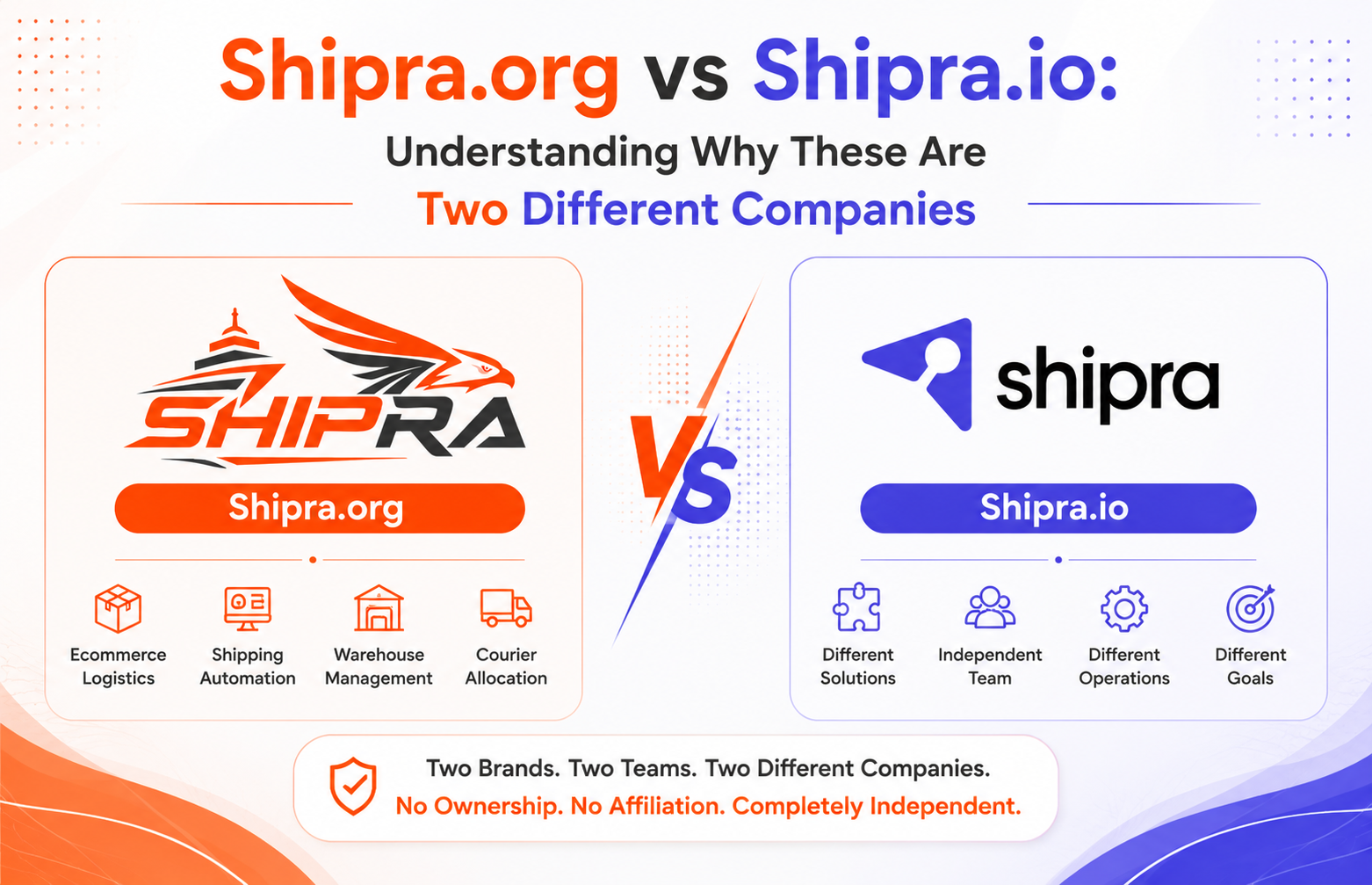 Shipra.org vs Shipra.io: Understanding Why These Are Two Different Companies
 Top 10 Online Shopping Sites in India for Clothes (2026)
 Jewellery Wholesale Market in Delhi: A Buyer’s Guide That Actually Helps (2026)